

 ICON Insights | July, 2026
Dr. Craig Callahan ICON Advisers – Founder & Executive Committee Chair
Equities
The S&P 1500 Index advanced 5.01% in May, putting it up 11.46% for 2026. As the old saying goes, “Wall Street climbs a wall of worry.” There are plenty of things for some investors to worry about: the war in Iran, the subsequent increase in energy prices, a potential increase in inflation, and the likelihood of the Federal Reserve discontinuing its monetary easing. It appears investors have focused, correctly, we believe, on corporate earnings. As of June 1,1452 of the companies in the S&P 1500 Index have reported corporate earnings. On average, they beat estimates by 15.50%,
with one standout sector, Consumer Discretionary, beating estimates by 35.81%. As for year-over-year (Y-O-Y) growth, it appears companies are experiencing an earnings surge; of the 1452 companies who have reported earnings, they’re, on average, 26.18% better than in 2025. Information Technology had the highest Y-O-Y growth at 48.63%, but other sectors less known for growth were impressive, such as Financials up 23.02%.
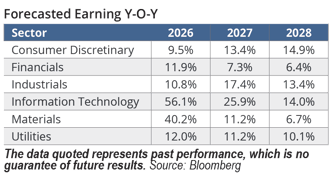 There are analysts on Wall Street who focus on forecasting earnings. Bloomberg surveys those analysts to then report their results. The table shows their Y-O-Y outlook for a few sectors for 2026, 2027, and 2028. You can see the surge in 2026, but continued growth into 2027 and 2028. It should be pointed out that they can be wrong, and they can revise their forecasts, but for the time being this group sees continuing prosperity. Utilities, while usually dull and not exciting, may be the most interesting sector. Historically, their Y-O-Y growth is in the 4% to 5% range. The double digit growth currently being estimated may be attributed to the potential power requirements for artificial intelligence and the large data centers.
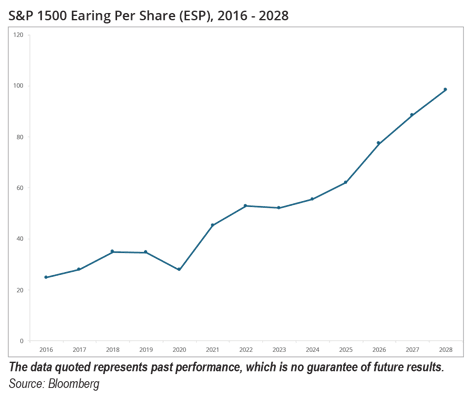
The graph shows the earnings per share for the S&P 1500 Index, where 2016 through 2025 is actual but 2026, 2027, and 2028 are estimates from the analysts mentioned above. There was a slight dip in 2020 when we shut down the economy to reduce the spread of COVID. Otherwise, earnings have been growing nicely.
Bonds
The yield on the 10-year Treasury note rose in March 2026, after the invasion of Iran, then paused in April. It rose again in mid-May to a peak of 4.66% but backed off at the end of May. Some analysts are calling for it to resume its upward path, but we do not agree. The yield seems very comfortable in the 4.5% range.
Summary
If a stock has earnings per share of $1.00 and a P/E ratio of 10, its price per share would be $10.00. If its earnings grow 48.63% Y-O-Y as they did for the Information Technology Index, its earnings would be $1.48. If it maintained a P/E of 10, the price per share would increase 48.63% to $14.86. Some analysts and investors have seen stock prices move higher over the last few years and predicted a bubble or market peak. We disagree. When we consider earnings, we find stocks, on average, to be fairly valued.
The data quoted represents past performance, which is no guarantee of future results. Opinions and forecasts regarding sectors, industries, companies, countries and/or themes, and portfolio composition and holdings, are all subject to change at any time, based on market and other conditions, and should not be construed as a recommendation of any specific security, industry, or sector.
Investing in securities involves inherent risks, including the risk that you can lose the value of your investment. An investment concentrated in sectors and industries may involve greater risk and volatility than a more diversified investment. Investments in international securities may entail unique risks, including political, market, regulatory, and currency risks. In general, there is less governmental supervision of foreign stock exchanges and securities brokers and issuers. Investing in fixed-income securities such as bonds involves interest rate risk. When interest rates rise, the value of fixed-income securities generally decreases.
Individual account holdings and composition may vary. Opinions and forecasts regarding sectors, industries, companies, countries and/or themes, and portfolio composition and holdings, are all subject to change at any time, based on market and other conditions, and should not be construed as a recommendation of any specific security, industry, or sector.
ICON’s value-based investing model is an analytical, quantitative approach to investing that employs various factors, including projected earnings growth estimates and bond yields, in an effort to determine whether securities are over- or underpriced relative to ICON’s estimates of their intrinsic value. ICON’s value approach involves forward-looking statements and assumptions based on judgments and projections that are neither predictive nor guarantees of future results. Value readings are contingent on several variables, including, without limitation, earnings, growth estimates, interest rates, and overall market conditions. Although valuation readings serve as guidelines for our investment decisions, we retain the discretion to buy and sell securities that fall beyond these guidelines as needed. Value investing involves risks and uncertainties and does not guarantee better performance or lower costs than other investment methodologies.
ICON’s value-to-price ratio is a ratio of the intrinsic value, as calculated using ICON’s proprietary valuation methodology, of a broad range of domestic and international securities within ICON’s system as compared to the current market price of those securities. According to our methodology, a V/P reading of 1.00 indicates stocks are priced at intrinsic value. We believe stocks with a V/P reading below 1.00 are overvalued, while stocks with a V/P reading above 1.00 are undervalued. For example, we interpret a V/P reading of 1.15 to mean that for every $1.00 of market value, there is $1.15 of intrinsic value which has not yet been realized in the market price.
The unmanaged Standard & Poor’s Composite 1500 (S&P 1500) Index is a broad-based capitalization-weighted index comprising 1,500 stocks of Large-cap, Mid-cap, and Small-cap U.S. companies. The unmanaged Standard & Poor’s (S&P) Composite 1500 Sector Indexes track the performance of sectors that comprise the S&P Composite 1500 Index. Total return figures for the unmanaged sector indexes do include the reinvestment of dividends and capital gain distributions but do not reflect the costs of managing a mutual fund. The Standard and Poor’s (S&P) 1500 Consumer Discretionary Index is an unmanaged capitalization-weighted index comprising companies in the Consumer Discretionary sector as determined by S&P. Total returns for the unmanaged index include the reinvestment of dividends and capital gain distributions beginning on January 1, 2002. Index returns with reinvested dividends and distributions are unavailable prior to that date. The Standard and Poor’s (S&P) 1500 Consumer Staples Index is an unmanaged capitalization-weighted index comprising companies in the Consumer Staples sector as determined by S&P. The Standard and Poor’s (S&P) 1500 Energy Index is an unmanaged capitalization-weighted index comprising companies in the Energy sector as determined by S&P. The Standard and Poor’s (S&P) 1500 Financials Index is an unmanaged capitalization-weighted index comprising companies in the Financials sector as determined by S&P. The Standard and Poor’s (S&P) 1500 Healthcare Index is an unmanaged capitalization-weighted index comprising companies in the Healthcare sector as determined by S&P. The Standard and Poor’s (S&P) 1500 Information Technology Index is an unmanaged capitalization-weighted index comprising companies in the Information Technology sector as determined by S&P. The Standard and Poor’s (S&P) 1500 Materials Index is an unmanaged capitalization-weighted index comprising companies in the Materials sector as determined by S&P. The Standard and Poor’s (S&P) 1500 Industrials Index is an unmanaged capitalization-weighted index comprising companies in the Industrials sector as determined by S&P. Total returns for the S&P 1500 Industrials Index include the reinvestment of dividends and capital gain distributions beginning on January 1, 2002. Index returns with reinvested dividends and distributions are unavailable prior to that date. The Standard and Poor’s (S&P) 1500 Real Estate Index is an unmanaged capitalization-weighted index comprising companies in the Real Estate sector as determined by S&P. The Standard and Poor’s (S&P) 1500 Utilities Index is an unmanaged capitalization-weighted index comprising companies in the Utilities sector as determined by S&P. Individuals cannot invest directly in an index.
The 10-year yield is the benchmark 10-year yield to maturity reflected by the current issue 10-year U.S. Treasury note.
Sources: Bloomberg
Please visit ICON online at ICONAdvisers.com or call 1-800-828-4881 for the most recent copy of ICON’s Form ADV, Part 2.
© 2026 ICON Advisers, All Rights Reserved.